
Year published: 2021
Category: Epic fantasy
Representation: m/m, side character
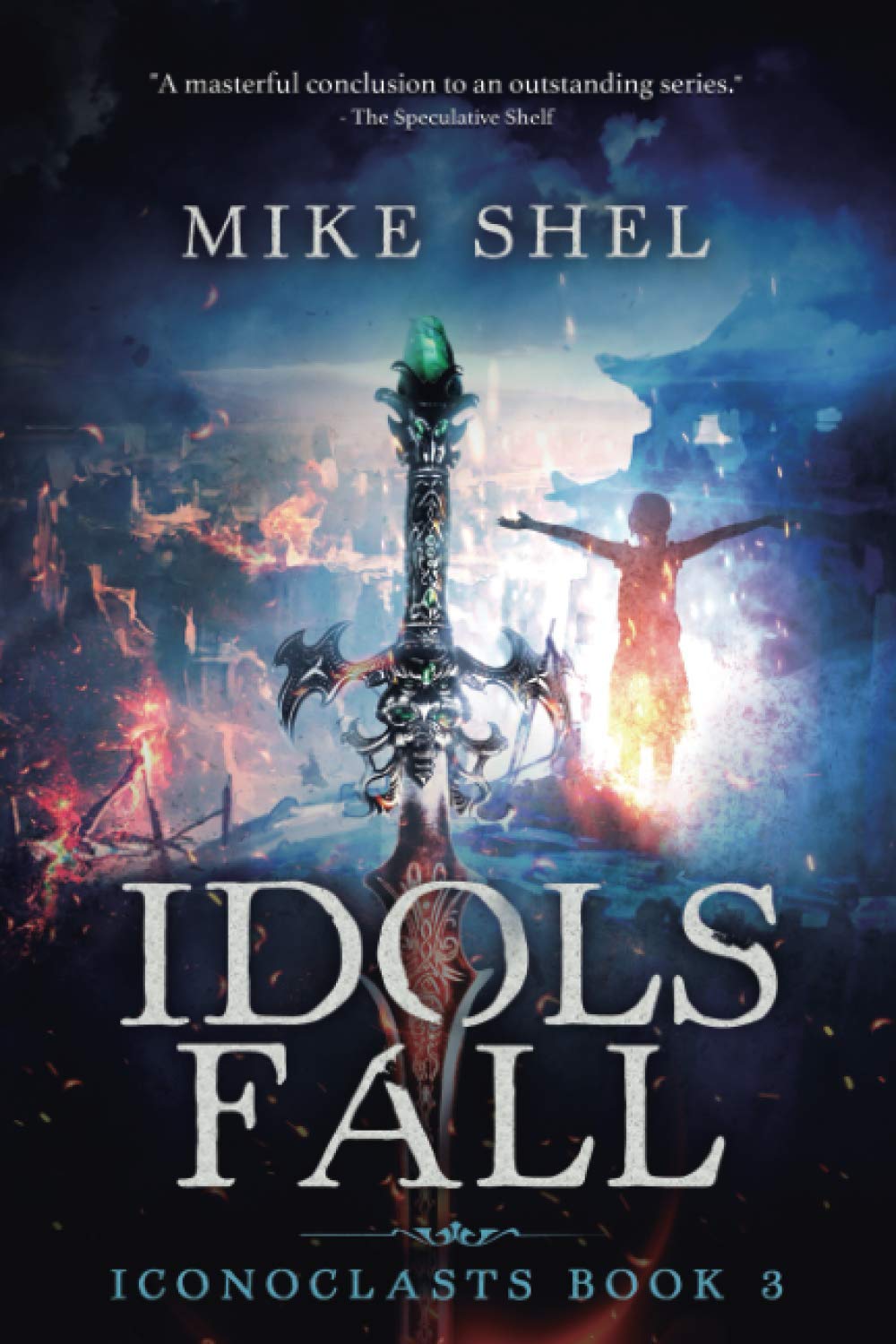
Summary: Agnes Manteo now bears her father’s sentient Djao sword, along with a terrible revelation—the gods are charlatans, ancient sorcerers who draw their strength from the suffering of humanity. She and her Syraeic companions have but one duty: to track down those pretenders and end their reign of cruelty and lies, no matter the cost. To that end, the magical blade—mighty, single-minded Szaa’da’shaela—won’t allow any wavering of their commitment.
But the empire is in turmoil with the sudden passing of its undying queen. Noble houses clash and threaten civil war, murderous barbarians mass on the frontier in preparation for a bloody invasion, and all feel the aching void left by the clergy, whose temples were devastated by a great fire. Can the kingdom survive should Agnes succeed in tearing away its very foundations?
And if she fails? What might sorcerers with nearly godlike powers do to exact their revenge?
Idols Fall is the thrilling conclusion to the compelling Iconoclasts trilogy.
My thoughts: I’m ultimately glad that I finished this series, but the last two books were pretty uneven reads for me. It’s clear that the author worked to incorporate new elements in each book, and some definitely ended up working better than others.
In Idols Fall, there is a lot of political scheming that wasn’t present in the other books. Barbarians are invading, and one part of the kingdom decides to rebel. We spend a lot of time on strategy meetings and political discussions where large numbers of place/people names are listed off without much context and uninteresting new characters are introduced to play very small roles throughout. One of the most egregious parts to me is a chapter that simply consists of a spy’s notes to the queen in order to infodump about all of this. I can appreciate trying to expand the story’s scope, but this element just didn’t feel incredibly effective, necessary, or interesting to me.
Something else that really stood out to me this time around was the in-world sexism. To be clear, I’m not a reader who automatically equates a book world’s violent/extreme misogyny with an author’s actual opinions; at the very most, I just think that some of Shel’s decisions were a bit misguided here. For example, there is a “comedy” “scene” where a man with a head injury just rambles on about breasts for FAR too long. Agnes faces a lot of gendered threats as well, getting called a cunt and encountering a man who threatens to “put her tits on [his] mantlepiece” (?). This series belongs to a fantasy subgenre I don’t read very often, so I guess I can’t really say whether stuff like this is just par for the course…regardless, though, it’s just really not for me.
It could be because she is being controlled by the sword throughout, but Agnes comes across as extremely erratic and belligerent here in a way that she didn’t in the previous books. I’m pretty sure that this was Shel’s intention because Auric similarly changed a lot when he found the sword; it just ended up feeling a lot more extreme and grating with Agnes.
With all this being said, though, I still enjoyed a lot of things here. I loved the horror, body horror, and disgusting creatures as much as ever, and I think the author has such a great talent for all of these elements. The actual dungeon trawling sections are always awesome in these books, as are the grim descriptions of the previous expeditions that have failed. I really appreciated the increasing tension over whether the ancient beings could be trusted, and I thought that the ultimate conclusion that Agnes and Ilanda came to about what to do with them was really satisfying and well-written (especially Ilanda’s section!). The section where the expedition travels back to Djao times was also a great choice. Best of all, my fave Chalca has the good sense to get far, far away from Agnes, and he’s therefore one of the only characters who actually survives all the way though the series. Good for Chalca! I hope he’s happy!
I started this series for my Trauma in SFF reading project and I’m not sure how relevant to that project the latter two books ended up being. Despite that, and despite my reservations, I am glad to have read them all and will be interested to see what Mike Shel does next.
 Charlotte Kersten
Leave a comment