
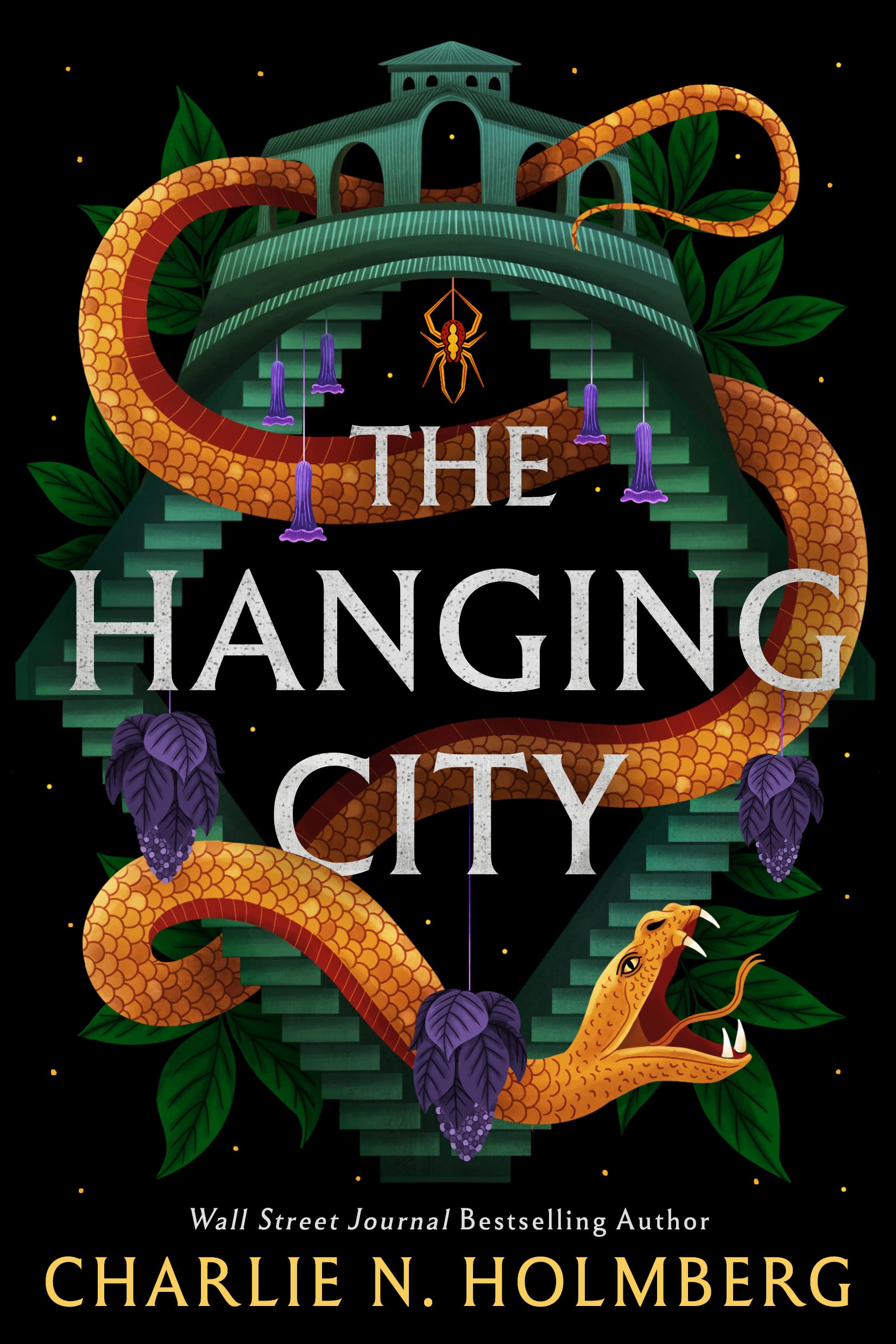
Year published: 2023
Category: Adult fantasy
Summary: Seven years on the run from her abusive father, and with no hope of sanctuary among the dwindling pockets of human civilization, Lark is out of options. Her only leverage is a cursed power: she can thrust fear onto others, leaving all threats fleeing in terror. It’s a means of survival as she searches for a place to call home. If the campfire myths of her childhood are true, Lark’s sole chance for refuge could lie in Cagmar, the city of trolls—a brutal species and the sworn enemies of humanity.
Valuing combat prowess, the troll high council is intrigued. Lark could be much more useful than the low-caste humans who merely labor in Cagmar. Her gift makes her invaluable as a monster slayer to fight off the unspeakable creatures that torment the trolls’ hanging city, suspended from a bridge over an endless dark canyon.
Lark will do anything to make Cagmar her home, but her new role comes with a caveat: use her power against a troll, and she’ll be killed. Her loyalty is quickly put to the test when she draws the hatred of a powerful troll who loathes humankind. Still, she finds unexpected friendship in the city and, even more surprisingly, love. But if everything else doesn’t undo her, being caught in the arms of a troll surely will. Now in the fight of her life, Lark has a lot to learn—about her past, about trust and hope when all seems lost, and above all, about the extraordinary power of fear itself.
My thoughts: I’ve meant to read a Charlie Holmberg book for a while now because her works seem like they could be right up my alley. In the first half or so of The Hanging City, I was really, really enjoying myself and sure that I’d be eagerly reading more of her stuff soon. Unfortunately, the book went seriously downhill for me in the second half, and it ended up being a pretty mediocre read by the end.
In the first half, the focus is mostly on Lark acclimating to life in Cagmar, the strange trollis city, in what I found to be a very enjoyable slice-of-life plot. She starts to learn about a unique new place, make friends, and develop hopes for the future. In the second half, the focus narrows in on her romance with Azmar to the book’s overall detriment. I’m no monsterf*cker, but neither am I inherently opposed to the idea of a Lark/Azmar romance. It just ends up moving incredibly quickly to the point that they are exchanging life-bond stones and declaring their love in what feels like no time at all. A lot of the stakes involve the romance after this point, and I just wasn’t totally convinced or onboard for it.
The other big problem is that there are SO many plot points that feel quite dubious and shaky in the second half. Sometimes a plot point or two will feel a bit contrived to me, but it’s rare to encounter so many one after another. Here is my list:
-While she is a prisoner, Lark flirts with a guard so that he won’t tie her rope bonds well, and this works
-While sneaking around the enemy camp, she finds all of the army’s strategic plans and diagrams in a random drawer that isn’t even in the general’s tent – it’s just the first random empty tent that she sneaks into by chance
-Azmar is able to save Lark from the soldiers trying to kill her because he sees her running away from her father from across a battlefield while he is fighting for his life
-Lark uses her powers to terrify Azmar so much that he gets up from dying after being impaled and runs back to the trollis healers
-She makes herself bait to summon a legion of monsters and is able to corral and herd them all with her powers before any of them attack her
-Azmar gets over his intense fear of Lark (after she’s used her powers on him) after one occasion of seeing her
-He convinces her that he still loves her by showing her old military papers demonstrating that his usual fear response is to fight instead of flee, so she was able to convince him to flee when she saved his life by terrifying him. I’m not really sure why this is important at all. (Side note: it’s a bit strange that fear/trauma responses are dichotomized into fight and flee in this book since I feel like the most common version you hear these days is fight/flight/freeze and most of the trauma research I’m familiar with now typically includes “fawn” and “flop” the other primary responses.)
So, yes. A lot of things had me raising my eyebrows towards the end. Charlie Holmberg wrote in her acknowledgements that she had to stop working on the book while struggling during COVID and was only able to return to it and finish it recently. I can’t help but wonder if this fact has something to do with how much the book changes as I described.
The other main thing that feels strange about The Hanging City to me is that it introduces an element of hatred between the humans and trollis in a very superficial way, and this conflict drives most of the plot…but I just don’t feel like the book goes beyond that to have much to say about it. An example is the way that Lark takes on the role of Unach and Azmar’s servant who has to do everything for them (and does it all eagerly) to “earn her place” and “deserve to stay in Cagmar” and be protected from the trollis who is stalking and trying to kill her. It’s a troubling dynamic given the fraught history between the species, the discrimination against humans (who are hated and treated as second-class citizens) in Cagmar, and the romance that develops between Lark and Azmar. Yet it’s never explored beyond this surface level understanding that discrimination is bad but this is just what Lark needs to do to get by and it’s good that Unach and Azmar are protecting her.
Despite these problems, I did enjoy the unique setting, slice-of-life first half, and sweet, optimistic protagonist enough to be interested in reading more books by this author. It’s just a shame that I wasn’t as enamored as I thought I would be starting out.
 Charlotte Kersten
Leave a comment