
Year published: 2017
Category: Sci-fi
Representation: F/f main characters
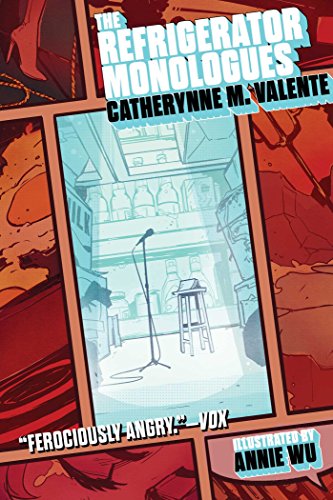
Summary: The lives of six female superheroes and the girlfriends of superheroes. A ferocious riff on women in superhero comics.
A series of linked stories from the points of view of the wives and girlfriends of superheroes, female heroes, and anyone who’s ever been “refrigerated”: comic book women who are killed, raped, brainwashed, driven mad, disabled, or had their powers taken so that a male superhero’s storyline will progress.
My thoughts: I’m so glad to have read another book by Valente after loving The Orphan’s Tales a couple years ago. As in her other books, the writing is incredibly strong here; Valente is just an amazingly clever, creative and funny writer. I will say I think that the very stylized voice feels too similar between all of the narrators except for Pauline, and I would have loved to see each character have a more unique individual voice and storytelling style. Each character also has some kind of passion or hobby – science, punk music, theater, art – that gets sprinkled into her story and talked about in very similar ways throughout; this also contributes to the similarity in their voices.
The overall theme of this collection is that a group of women gather in Hell to tell their stories each day. Having lived in a world where superheroes are real, they have all been “fridged” – they have suffered and died so that men could become more powerful, get revenge, fight in epic battles, experience character growth etc. etc. In the living world, they are no more than pawns in men’s stories, but in Hell, they are able to form a sisterhood to support each other, reclaim their stories, and stay somewhere where they will not be hurt anymore. Valente goes for the throat much of the time, making clear how hackneyed these woman fodder stories are as they play out over and over again. She also shows that the women who are punished by the narratives they’re in are often those who are “more” than they should be, more than is convenient for the men/superheroes in their lives.
Their stories vary around these basic themes. Paige Embry’s scientific research created a beloved superhero’s powers; Julia Ash became too powerful for others’ comfort and was consequently trapped and controlled in a villain’s timeloop. Samantha Dane did gruelling minimum wage work to support her boyfriend while he slowly figured out his powers and started to fight crime.
I was particularly struck by the story of Daisy Green, a woman left her beloved superhero boyfriend and carved out a life without him before dying a “nondescript” death from drug addiction. There is a great bit of writing where she compares sex work to a superhero’s work and points out how sex work is degraded and devalued despite all it shares in common with other kinds of work that are praised instead. A line that’s stayed with me from this story is Daisy’s reflection on how the growing stigmatization of sex work pushed her into shame and danger that didn’t exist before: “I was not ashamed until they made me ashamed.”
My favorite story was probably that of Pretty Polly/Pauline Ketch, who is based on Harley Quinn. This story has the most distinct voice of them all and Valente’s sense of humor and talent are on full display in how well she nails that particular brand of Harley’s dangerous, delightful zaniness. I also spent a lot of this story laughing at how she described Grimdark, this world’s Batman, and the Joker equivalent character’s obsession with him.
Bayou’s story was probably my least favorite because there was just so much going on throughout and it all felt somewhat disjointed. Over the course of the story, she goes from punk singer mermaid to mother to queen to superhero (of her own sort) to being locked in an asylum within the span of a few pages, and it just felt like too much to me.
Overall, I really enjoyed this collection and just wish I knew more about superhero lore because there were probably a lot of references I missed. As a tangential suggestion, another book I enjoyed with a pretty similar premise is How to Be Eaten by Maria Adelmann.
 Charlotte Kersten
Leave a comment