
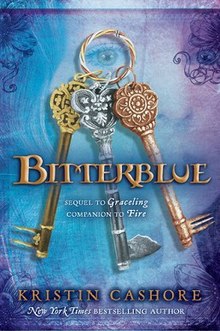
Year published: 2012
Category: Epic fantasy (YA)
Summary: Eight years have passed since the young Princess Bitterblue, and her country, were saved from the vicious King Leck. Now Bitterblue is the queen of Monsea, and her land is at peace.
But the influence of her father, a violent psychopath with mind-altering abilities, lives on. Her advisers, who have run the country on her behalf since Leck’s death, believe in a forward-thinking plan: to pardon all of those who committed terrible acts during Leck’s reign; and to forget every dark event that ever happened. Monsea’s past has become shrouded in mystery, and it’s only when Bitterblue begins sneaking out of her castle – curious, disguised and alone – to walk the streets of her own city, that she begins to realise the truth. Her kingdom has been under the thirty-five-year long spell of a madman, and now their only chance to move forward is to revisit the past.
Whatever that past holds.
Two thieves, who have sworn only to steal what has already been stolen, change her life forever. They hold a key to the truth of Leck’s reign. And one of them, who possesses an unidentified Grace, may also hold a key to her heart . . .
My thoughts: Welcome to Round ? of “Charlotte starts a popular YA fantasy series in the middle because none of the other books sounded interesting to her.” In this case, I don’t feel especially compelled to continue the series now that I’ve sampled what the Graceling Realm has to offer.
The first thing that I just have to get off my chest is that I hated Saf and his part in the plot. He was mean, always angry and unreasonably petulant. The entirety of the plot with the stolen crown felt like it took up an enormous amount of space in the book while also not really contributing to it in a meaningful way at all. Saf and Bitterblue did not interact enough to make their romance compelling, especially because they spent most of that time arguing and lying to each other. Then he left at the end and I think it was supposed to be somehow bittersweet, but I didn’t feel it at all. Bitterblue’s relationship with Giddon was a lot more convincing and I spoiled for myself that they end up together eventually – this leaves me wondering why anything with Saf was necessary at all.
Okay, rant over. There were also a lot of mysteries going on all at once in this book. I don’t necessarily think there were so many as to be confusing to the reader, but it did lead to the book feeling somewhat disjointed and chaotic and it really killed the pace. I also like mysteries that I might be able to figure out based on the clues given in the text, and that wasn’t really possible here. I will also say that almost everyone was lying and hiding things, which got quite repetitive. Bitterblue spent large chunks of the story, in the second half in particular, simply ordering people to investigate things for her and then waiting for them to report back to her. I am sure that I would’ve had more interest in the sections with Katsa, Po and the Council if I had read the books with them as the main characters, but, reading as I did, I found their sections somewhat repetitive too – they showed up, used their magic to further the plot and then left to go do their own things for a while.
That being said, I think the central conceit exploring memory and collective trauma was very interesting. An entire country was essentially mind-raped for decades and then had to find a way to move forwards afterwards. The healers, for instance, tried to deal with what happened to them and what they were forced to do by hiding it from everyone and destroying the evidence, but the book’s ultimate conclusion was that the country’s healing will come from knowing the truth, documenting it and sharing what they experienced. I loved Bitterblue’s creation of the Ministry of Truth and Stories for that purpose. Bitterblue’s mother’s story, told through her coded embroidery, was harrowing and tragic and very well done, as was Thiel’s story. Finally, I also really appreciated Bitterblue’s journey to become a confident leader in the wake of so much chaos and devastation. I loved the scene where Fire helped Bitterblue see that she was a strong queen and could help her country encompass its hurts.
I think, in summary, that these themes are important and powerful ones and I’m glad the book approached them – I just think that exploration was muddied by the number of plots happening at once, the sheer amount of repetition involved and the inclusion of a totally unnecessary and very annoying romance. What could have been very impactful ended up being less resonant to me because of how unwieldy the overall book felt
 Charlotte Kersten
Leave a comment