
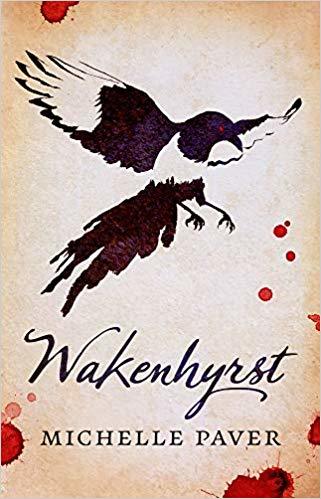
So What’s It About?
1906: A large manor house, Wake’s End, sits on the edge of a bleak Fen, just outside the town of Wakenhyrst. It is the home of Edmund Stearn and his family – a historian, scholar and land-owner, he’s an upstanding member of the local community. But all is not well at Wake’s End. Edmund dominates his family tyrannically, in particular daughter Maud. When Maud’s mother dies in childbirth and she’s left alone with her strict, disciplinarian father, Maud’s isolation drives her to her father’s study, where she happens upon his diary.
During a walk through the local church yard, Edmund spots an eye in the undergrowth. His terror is only briefly abated when he discovers it’s actually a painting, a ‘doom’, taken from the church. It’s horrifying in its depiction of hell, and Edmund wants nothing more to do with it despite his historical significance. But the doom keeps returning to his mind. The stench of the Fen permeates the house, even with the windows closed. And when he lies awake at night, he hears a scratching sound – like claws on the wooden floor…
Wakenhyrst is a terrifying ghost story, an atmospheric slice of gothic, a brilliant exploration of the boundaries between the real and the supernatural, and a descent into the mind of a psychopath.
What I Thought
This was my pick for my 2024 r/fantasy bingo square Set in a Small Town and one of the horror books I chose to read in October. It was ultimately an extremely sad read with very minimal supernatural elements but a lot of horror in other forms.
One of the most prominent elements in the books is an incredibly bleak view of pregnancy and women’s lack of reproductive autonomy. Through Maud’s dawning understanding of her mother’s plight and the writings of a female medieval mystic, we see a cycle of still-births and miscarriages where men’s sexual satisfaction and concern with establishing a family legacy dictate all reproductive choices and trump any concern for their wives’ well-being, leading to their extreme suffering and death.
Maud’s father is an easy character to hate because of this in combination with his abuse of a young servant girl and his complete lack of regard for Maud as a person with potential or interiority. His tyranny and extreme misogyny start to spiral into obsessive paranoia and he becomes yet more despicable as ill deeds from his past and plans for future violence start to emerge as well. If I have one complaint about this part of the story, it is that his rambling journals take up a great deal of page time as he continually decompensates and rationalizes things to himself.
My personal preference would have been to spend more time in Maud’s perspective, because she is a very endearing and compelling young heroine – despite being ignored and stifled in an extremely oppressive home after losing her mother, she is a girl who bursts with creativity and sensitivity and passion. Perhaps the most tragic part of the book, for me, is seeing how its events take a life with so much vibrancy and promise and turn it into something incredibly restricted due to the loss of those who truly love her and the horrible impact of her father’s violence.
Wakenhyrst is set in a tiny, ancient village on the edge of England’s fens, which hold a sense of vast power and allure for Maud. Part of her fight against her father becomes a fight to preserve the fens as he tries to drain them in his insanity. The descriptions of nature, religious fervor, ancient Christian mysticism and isolated village life in the book are incredibly transportive and effective in creating a sense of isolation, dread and wonder.
As I mentioned, any actual supernatural elements are fairly negligible, although just present enough for me to decide that the book still counts for my bingo square. This is an excellent read for bleak Gothic horror that is feminist and extremely atmospheric, but readers who are looking for lots of explicitly *real* curses or hauntings might want to look elsewhere first.
 Charlotte Kersten
Leave a comment