
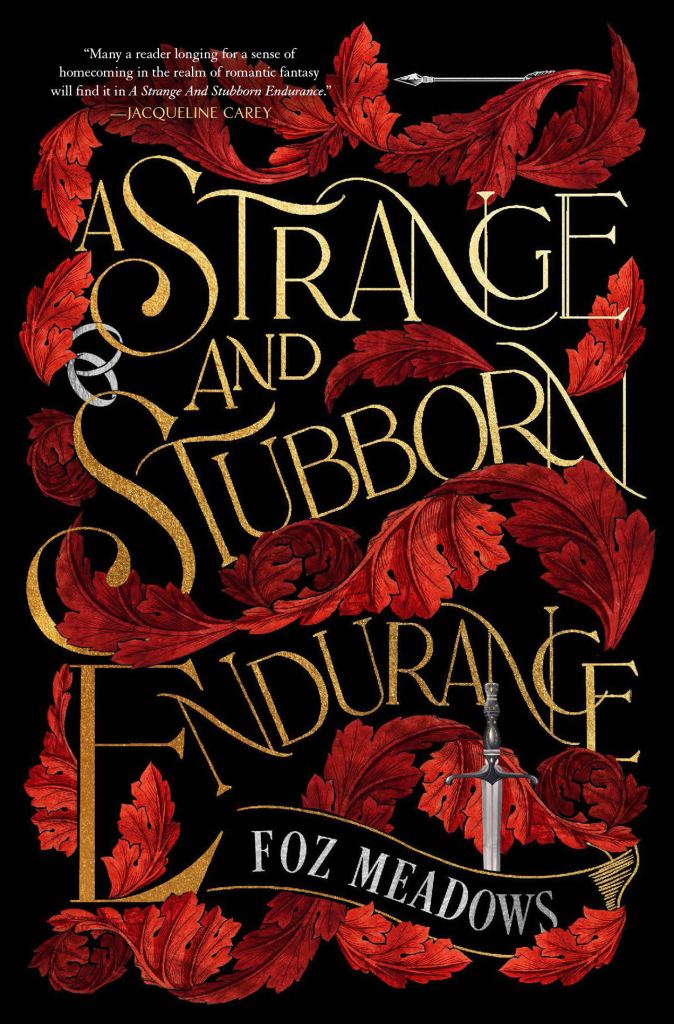
Velasin vin Aaro never planned to marry at all, let alone a girl from neighboring Tithena. When an ugly confrontation reveals his preference for men, Vel fears he’s ruined the diplomatic union before it can even begin. But while his family is ready to disown him, the Tithenai envoy has a different plans: for Vel to marry his former intended’s brother instead.
Caethari Aeduria always knew he might end up in a political marriage, but his sudden betrothal to a man from Ralia, where such relationships are forbidden, comes as a shock.
With an unknown faction willing to kill to end their new alliance, Vel and Cae have no choice but to trust each other. Survival is one thing, but love―as both will learn―is quite another.
Byzantine politics, lush sexual energy, and a queer love story that is by turns sweet and sultry, Foz Meadows’ A Strange and Stubborn Endurance is an exploration of gender, identity, and self-worth. It is a book that will live in your heart long after you turn the last page.
Review
A Strange and Stubborn Endurance spins a lot of plates at once – romance, political intrigue, murder mystery, journey of self-discovery and healing – and the result was a thoroughly odd reading experience that has now led to a very long review.
Of the book’s different elements, I was (of course) first drawn to the personal story of Velasin’s trauma recovery, which ties closely to his growing love for his husband via arranged marriage. A scan of reviews says that readers are mixed on the execution here, mainly criticizing the fairly graphic sexual assault at the start of the book and how quickly Vel seems to start healing/recovering. I’m not really bothered by the timing of the assault or the fact that Vel is in a much more positive state at end of the book despite not that much time having passed from the start; there are plenty of people who experience something traumatic and do start to recover quickly and I think that’s a totally valid choice for a story in general. Some of the more grounded mental health details where he questions his own responses (like a desire to have sex and generally feeling better) help make this work fairly well for me.
My problem with this part of the book really ties into how it’s interwoven with the rest of the story and the overall wonky writing…which is to say there are a LOT of jarring tonal shifts throughout. There are some awkward moments of exposition during essential moments in the beginning, for example: immediately after he finds out that he’s going to marry a man instead of a woman due to being forcibly outed via his sexual assault, we are graced with a random paragraph about how magic works in this world before shifting to his emotional reaction to this news. In an infodumping move that I now automatically associate with the Fourth Wing parapet, he also tries to quell his nighttime panic by mentally reciting the precise rules for how magic works a while later.
More generally speaking, once Vel is in Titherai, the plot settles into a sort of strange ping pong back and forth between assasination attempts, bloody murders and the blossoming of a sweet hurt/comfort romance between Vel and Cae. It’s hard to feel any gravity or urgency regarding the murders when we shift from seeing Vel’s beloved horse with its throat slit to details about how beautifully his new room is decorated and how yummy the food his husband orders for him is; right after Vel murders his abusive ex to stop him from murdering Cae, they just go right back to their wedding party and the focus shifts back to the wedding kissing game and all the witty banter.
The plot also suffers from focusing heavily on political intrigue that just doesn’t make that much sense! The justification for the original arranged marriage is to vaguely improve “diplomatic relations” between the two neighboring countries, and lip service is paid to needing to maintain diplomacy throughout, but no one really considers the fact that one of the countries is violently homophobic and might not approve of a m/m instead of a m/f pairing, especially when the man from Titherai is a renowned military figure who killed many Ralians.
Similarly, when Vel’s abusive ex tracks him down in Titherai, he and Cae decide to use Cae’s extrajudicial aristocrat loophole powers to brand him as a rapist with a soldering iron, citing a desire to not have to deal with the full legal process or cause “diplomatic concerns” by drawing attention to the incident. I might have missed an explanation here, but I just do not see why extrajudicially branding a man would be worse for diplomatic relations than a legal case???
The conclusion to the murder mystery comes about because Vel and Cae literally walk in on the villain shouting incriminating things at her accomplice, and then they inexplicably try to have a family sit-down meeting with her about what she’s done when she runs away back home. She promptly massacres several more characters in what amounts to a tantrum due to being the overlooked sibling and not having her family believe in her enough.
It’s just a lot to take in overall, and I think Meadows could have told a much more successful and focused story if he had just focused on the romance, self-discovery/acclimation, and healing aspects of the story instead. It’s a perfectly sweet relationship where there is a lot of fanfic-y banter and growing trust/attraction and a full conversation where both men are like How will I ever be a worthy partner to someone as amazing as you?? And then the other one is like No YOU are the amazing one and I am not worthy of you!!! There are also a lot of conversations that essentially just boil down to comparing how things are done in repressed, conservative Ralia and progressive, accepting Titherai, but I do like this part of the story most of all. There are some nice touches like a description of how magic can be used to help with gender-affirming care.
Some things definitely don’t come across the way they are intended; the whole thing where aristocrats can bypass due process to do punish people however they want is one of those things that feels super weird but is entirely unexamined by the story because the aristocrats in Titherai are good people!!!! Similarly, there is a LOT of emphasis on Vel and Cae being soooooo nice to all of their servants and immediately being adored by every servant in a way that ultimately feels more cringey and condescending than anything else.
The overall effect of everything I’ve described here is definitely entertaining, but not necessarily always in ways that the author intended, I think. I do appreciate the parts of the book that are grounded in kindness, hope, and acceptance but there are just a lot of other weird moving pieces that detract and distract from that.
 Charlotte Kersten
Leave a comment