
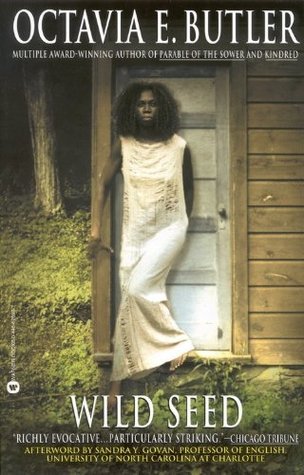
Doro is an entity who changes bodies like clothes, killing his hosts by reflex or design. He fears no one until he meets Anyanwu. Anyanwu is a shapeshifter who can absorb bullets and heal with a kiss and savage anyone who threatens her. She fears no one until she meets Doro. Together they weave a pattern of destiny (from Africa to the New World) unimaginable to mortals.
Review
Octavia Butler’s books are spare, deliberate and relentless, and Wild Seed is no exception to this. It engages with questions of exploitation, control, and autonomy with fierce clarity. On one level, the central conflict between Anyanwu and Doro can be seen as a feminist struggle between Butler’s interpretations of patriarchal and matriarchal power and society-building: Doro dehumanizes the occupants of his seed villages and thinks nothing of killing them or destroying their lives. When their powers cause them endless agony he views it as an inconvenience, worrying only about the pursuit of his own goals. Anyanwu builds flourishing communities based on compassion and the fundamental value of all human lives. It is a matter of control opposed to cooperation; destruction opposed to nurturance. Written in a time where complex and autonomous black heroines were almost a non-entity in speculative fiction, Wild Seed celebrates Anyanwu’s resilience and struggle for agency, as well as her warmth, capacity for love and strong sense of morality. In addition, she gradually becomes comfortable enough to explore her ability to change genders/reproductive organs and cherish both male and female lovers. It is also a thoroughly Afrocentric novel where Anyanwu struggles to retain her Igbo values in the American colonies, and where immense emphasis is put upon her kinship networks. Anyanwu’s coerced journey from her African home to the New World can be viewed as a kind of slave narrative, where her ability to reproduce is exploited for Doro’s gain and she fights back and struggles with her own agency. There is also the matter of the secret plantation haven she creates to hide from Doro in the depths of the antebellum South:
‘She owned no slaves. She had brought some of the people who worked for her and recruited the others among freedmen, but those she bought, she freed. They always stayed to work for her, feeling more comfortable with her and each other than they had ever been elsewhere. That always surprised the new ones. They were not used to being comfortable with other people. They were misfits, malcontents, troublemakers- though they did not make trouble for Anyanwu. They treated her as mother, older sister, teacher, and when she invited it, lover. Somehow, even this this last intimacy did nothing to diminish her authority. They knew her power. She was who she was, no matter what role she chose.”
Doro’s side of the story, with his relentless, ruthless drive to create a new type of human like himself, has a great deal to say about eugenics. Specifically, his cruelty demonstrates Butler’s concerns about the dehumanization, devaluation of human life and abuse of power that she could not see becoming disentangled from enugenics and its goals. Doro’s creation and control of “seed villages” can also be understood as a colonial project, with him as the embodiment of a colonizer in his exploitation and violence. As the book takes place in America from 1641 to 1841, there is also a great deal of commentary upon the nature of slavery. Doro works with European slavers in Africa to select and buy promising “stock” for his seed villages, and he maintains absolute control over the lives of his people, breeding them to perpetuate his own cruel goals and deciding how they live and when they live and die. The matter of his relationship with Anyanwu is at its heart one of control: he seeks to dominate her through coercion, isolation and the use of her family and community as leverage:
“Doro followed, thinking that he had better get her with a new child as quickly as he could. Her independence would vanish without a struggle. She would do whatever he asked then to keep her child safe…once she was isolated in America with an infant to care for, she would learn submissiveness.”
Despite all of this, there remains a strange kind of connection and sense of kinship between them because of their shared status as immortal shapeshifters. It is with this in mind that we come to the ending. I don’t know quite what to think of the ending, to be honest. I think it can be interpreted two ways. The first is this: Anyanwu continues to fight against Doro’s power and leads her own prosperous community, and Doro begins to respect her autonomy a bit more. He “continue[s]” to do loathsome things” but “no longer [does] them to her,” and this is as good as love for him. She is driven to the point of suicide by continual losses but changes her mind and decides that there is hope when Doro finally admits that he needs her. They come to a strange kind of compromise. The second interpretation is this: Anyanwu has struggled for centuries against Doro’s abuse, and finally loses the will to fight as she has fought before, concluding that suicide is her only escape. Doro inflicts his manipulation upon her again, and she concedes to his desire that she live:
“She had submitted and submitted and submitted to keep him from killing her even though she had long ago ceased to believe what Isaac had told her – that her longevity made her the right mate for Doro…she had formed the habit of submission…habits were difficult to break.”
Even if we accept the more optimistic possibility, it is still a deeply precarious resolution. Doro is not redeemed, and the changes that he has made in concession to Anyanwu at the end are not extensive: fundamentally, she “uncomfortably” settles into a life of protecting her community from Doro while maintaining a romantic relationship with him. I struggle with ambiguity in my book endings – it’s difficult for me to sit with a lack of resolution. But why would I ever expect simplicity or an easy way out from Octavia Butler?
 Charlotte Kersten
Leave a comment