
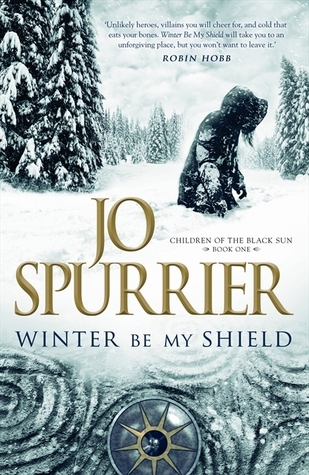
A complex, adult epic fantasy from a new Australian author … original, dramatic, unputdownable …
Sierra has a despised and forbidden gift — she raises power from the suffering of others. Enslaved by the King’s Torturer, Sierra escapes, barely keeping ahead of Rasten, the man sent to hunt her down. Then she falls in with dangerous company: the fugitive Prince Cammarian and his crippled foster-brother, Isidro.
But Rasten is not the only enemy hunting them in the frozen north and as Sierra’s new allies struggle to identify friend from foe, Rasten approaches her with a plan to kill the master they both abhor. Sierra is forced to decide what price she is willing to pay for her freedom and her life …
Original, dramatic and unputdownable, Winter Be My Shield is the first in an epic fantasy trilogy from brilliant new Australian talent Jo Spurrier.
Review
I knew that a blurb by Robin Hobb was a good sign, and now that I’m finished with Winter Be My Shield, I can say with confidence that a Robin Hobb recommendation fits this book really, really well. It’s similarly comparable to Carol Berg, I would say – epic fantasy with a strong emphasis on character psychology and Immense Amounts of Suffering.
There are three main characters, but the majority of the focus is split between Isidro and Sierra. Isidro is an exile and rebel against his homeland’s corrupt royalty who starts the book struggling to find his sense of self and place in the world after being rendered disabled by torture, and he ends the book enslaved and still being horrifically tortured. Sierra, a mage with incredibly strong powers, has just escaped the captor (also Isidro’s torturer) who has enslaved her to exploit magic since she was a child. After fleeing into the brutal winter wilderness, she unites with Isidro and his fellow companion Cam in a desperate attempt to remain free.
From that basic description, you may be able to ascertain where most of the Intense Suffering I described comes from – there is a LOT of torture and slavery in this book. Rape, the threat of rape, and the impact of rape all feature heavily too. Something about Spurrier’s approach to these topics feels matter of fact and practical in a way that strikes me as refreshing when the depictions could have been a lot more voyeuristic or gratuitous instead. To me, at least, her handling of the trauma feels authentic to a cast of characters who have been immersed in the harsh logic of their world for a long time but are actively trying to resist it and find another way to live. They spend the majority of this book in pure survival mode where desperation and practicality are prioritized over any kind of deep, prolonged introspection, but the narrative still feels focused on their psychology in the way I described above.
Sierra’s story definitely stands out the most to me as I look back to write this review, partially because of the complex relationship she has with Rasten, the fellow captive and mage who is sent to track her down. Although his actions and mindset are truly reprehensible, Spurrier writes him well enough that the reader gets a sense of how he was shaped into what he is now and how he makes sense of his feelings for Sierra and still tries to resist complete control by his master. I think I was also drawn to Sierra’s story because of how infuriating it is to see her perpetually betrayed and mistrusted because of her magic, only to be backed into corners where she has to use her power in terrible ways. In a way, the stigmatization of magic reminds me a bit of how the topic is explored in Dragon Age – clearly not a one-for-one oppression metaphor but a conversation about what the “right” way to handle that much power is while preserving the humanity of those bearing it instead of dehumanizing them by turning them into weapons or pariahs.
I also appreciated some of the nuances in how Spurrier writes about the dynamics of a society where slavery is normalized – the mundane dehumanization practiced by characters who otherwise come across as perfectly “normal,” for example, or the double standards around sexual entitlement for male vs female slaveholders. The sum of all these elements I’ve described so far is an interesting look at the ways that very different characters make sense of and try to survive the violence engrained in their world, both as perpetrators and survivors.
All of this being said, Winter Be My Shield did leave me just slightly itching for a bit more. The plot remains intense and engaging throughout and the writing flows well, but something or other kept it from reaching the level of truly phenomenal epic fantasy for me. By the end I think I’d gotten a bit fatigued with the amount of characters getting kidnapped, tracking/chasing each other and/or giving up and turning around. There are also a lot of instances of characters getting repeatedly, grievously wounded and then healed – another Hobb comparison! Very solid overall, though, and just the kind of epic fantasy I enjoy.
 Charlotte Kersten
Leave a comment