
What cannot be healed must be transcended.”
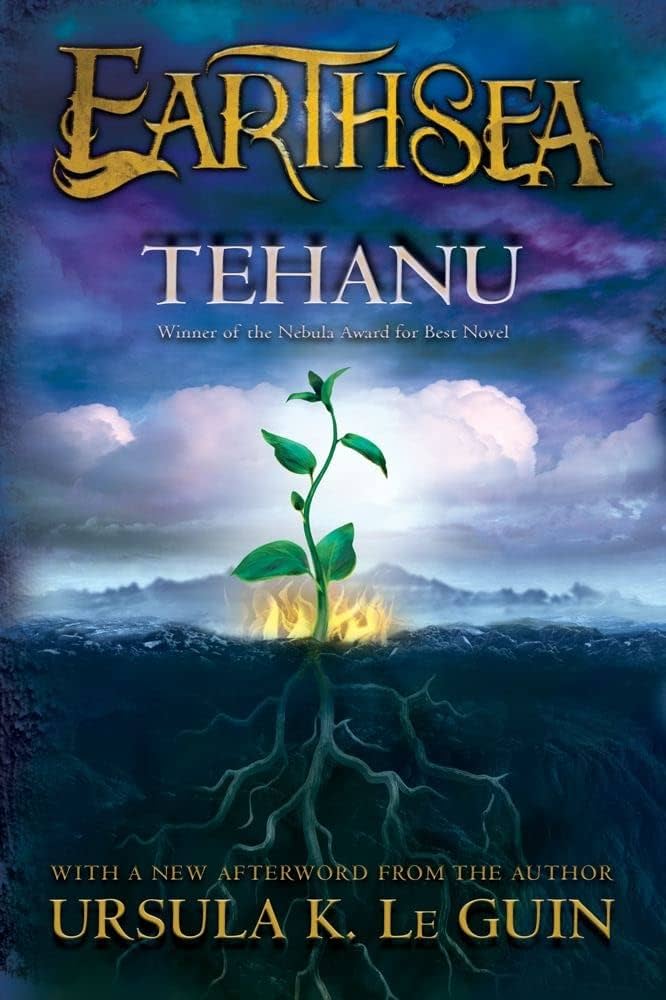
Year published: 1990
Categories: Adult, fantasy
Summary: Tenar, last seen as a teenage girl in The Tombs of Atuan, is now well into middle age and widowhood. After having felt adrift for some time, she finds a new sense of purpose when she takes in a severely burned little girl who was left for dead by her abusive parents. She and the girl, Therru, settle into life together, but their pattern is once again disturbed when Ged returns to Gont near death and bereft of his magic. What follows is a reflection on the true meaning of power and what it means to live in its absence.
My Thoughts: Very few books have ever resonated with me quite as much as Tehanu did. It’s nothing short of brilliant in my view, a quietly transformative, meditatively powerful reflection on some of the most fundamental questions that characterize my own life. There are three key thematic strands that deftly weave their way through Tehanu’s narrative, dealing chiefly with trauma, gender and power and how the three are inextricably linked.
“What cannot be healed must be transcended.”
There are some wrongs that may never be righted, there are some hurts that will never heal. But if this is true, how do you nevertheless forge onwards, find meaning in life and be more than what has been done to you? Maybe that transcendence looks different for everyone. It’s how Tenar made the choice to fight for a normal, peaceful existence with a farm and a husband and children after the unimaginable darkness of her childhood. It’s how Therru takes tiny, miraculous steps towards feeling safe and expressing herself through play and speech and trust in adults. It’s how Ged slowly makes sense of his new identity after his entire life has been shattered.
Tehanu makes it clear that the act of enacting harm against someone is also an act of expressing your power over them:
“It’s so easy, she thought with rage, it’s so easy for Handy to take the sunlight from her, take the ship and the King and her childhood from her, and it’s so hard to give them back! A year I’ve spent trying to give them back to her, and with one touch he takes them and throws them away. And what good does it do him—what’s his prize, his power? Is power that—an emptiness?”
The power that you achieve through harming others is, as Tenar puts it, “an emptiness,” but even the allure of that empty power is enough for some people to justify their actions against others. What is agonizing about this is how incredibly easy it is to enact that destructive power against others, while building up true constructive power through love and connection is a delicate process that requires time, vulnerability and trust.
There is also the question of the stigma that accompanies trauma. Therru carries the physical markings of what has been done to her, and because of that people fear and shun her. They cannot stand the thought of a child being thrown into the flames or raped or beaten, and deal with that inability by projecting their fear and disgust onto the survivor instead of the perpetrator. Just as it is easier to tear someone down for empty power, it is easier to blame a victim than it is to confront a world where parents would be capable of doing what has been done to Therru. I never loved Tenar more than when she insisted on how wrong this was, and told Therru that she is defined by who she is and what she can do instead of what has been done to her:
“You are beautiful,” Tenar said in a different tone. “Listen to me, Therru. Come here. You have scars, ugly scars, because an ugly, evil thing was done to you. People see the scars. But they see you, too, and you aren’t the scars. You aren’t ugly. You aren’t evil. You are Therru, and beautiful. You are Therru who can work, and walk, and run, and dance, beautifully, in a red dress.”
Tehanu is equally preoccupied with questions of masculinity and femininity as it is with questions of trauma. There are several meditations on inherently “masculine” and “feminine” types of power, and my favorite of these occurs between Tenar and a witchwoman named Moss. Tenar asks Moss what is wrong with men, and Moss replies as follows:
“The best I can say, it’s like this. A man’s in his skin, see, like a nut in its shell … It’s hard and strong, that shell, and it’s all full of him. Full of grand man-meat, man-self. And that’s all. That’s all there is.”
A woman’s a different thing entirely. Who knows where a woman begins and ends? Listen mistress, I have roots, I have roots deeper than this island. Deeper than the sea, older than the raising of the lands. I go back into the dark … I go back into the dark! Before the moon I am, what a woman is, a woman of power, a woman’s power, deeper than the roots of trees, deeper than the roots of islands, older than the Making, older than the moon. Who dares ask questions of the dark? Who’ll ask the dark its name?”
Moss has completely subscribed to the idea that there are inherent, boundless differences between men and women and the kinds of power that they embody. It can be tempting to subscribe to this view sometimes – that women are essentially divine, mystical, pure and powerful in a way that men are not. Tenar, however, and Le Guin, do not seem to be convinced by this idea. Tenar mildly responds that the horrors of her childhood were perpetrated entirely by women, complicating Moss’s celebration of pure, mystical female power. Later, she says the following to Ged:
“It seems to me we make up most of the differences, and then complain about ’em.”
By arguing that we “make up most of the differences,” Le Guin supports the notion that sex and gender by and large social constructs that we perpetuate in order to simplify the world into easy, false dichotomies. “Making up most of the differences” also complicates notions of biological essentialism that dictate certain traits as inherently masculine or feminine.
What is clear, however, is that while gender may have started out as a social construct, it has come to be an extremely real thing to the people who live within its rules, power dynamics and expectations on a daily basis. The impact of gender expectations is conveyed most clearly through Ged’s story- the “unmanning” that he experiences in Tehanu through the loss of his magic. When Ged loses his magic – his masculine-coded power-he experiences an agonizing identity crisis. His shame puzzles Tenar:
“But even so she did not feel she understood his shame, his agony of humiliation. Perhaps only a man could feel so. A woman got used to shame.”
In this way it is clear that Ged’s shame as a result of his loss of power is gendered as well – a woman, who lives with a constant lack of power and plenty of the shame that accompanies being a denigrated gender-cannot be caught up by the conundrum of ego that masculinity causes.
For a significant portion of the book, Ged essentially sees himself as nothing without his magic, and as a result is completely cowed, self-absorbed and emotionally stunted, unwilling to care about anything but nursing his wounds and stewing over his downfall:
“Ged—the one who might really have helped—Ged ran away. Ran off like a whipped dog, and never sent sign or word to her, never gave a thought to her or Therru, but only to his own precious shame. That was his child, his nurseling. That was all he cared about. He had never cared or thought about her, only about power—her power, his power, how he could use it, how he could make more power of it. Putting the broken Ring together, making the Rune, putting a king on the throne. And when his power was gone, still it was all he could think about: that it was gone, lost, leaving him only himself, his shame, his emptiness.”
This, Le Guin argues, is what our construction of masculinity can make of men. Even a courageous, heroic, truly good man like Ged has built his entire identity upon having more power than other people, and when that is no longer the case he reverts back to being a terrified, emotionally-repressed teenager again. The rest of the wizards in the book are presented in much the same light- emotionally repressed, terrified of losing their power, and arrogant. It is only when Ged’s worst fears do in fact come true that he is able to actually begin to live in a genuine way and forge a healthy identity for himself as a real man as opposed to a man whose entire sense of himself is constructed on notions of empty power. As Le Guin puts it in the afterward:
“In Tehanu he can become, finally, fully a man. He is no longer the servant of his power.”
This is the strange, pitiable paradox of masculinity: men have constructed themselves as the more powerful gender, but this construction of power leads to constant fears of being perceived as weak and unmanly. Again we come back to the notion of empty power- if your power is built on others’ fear and leads to your own constant fear of weakness, what is it truly worth? And with that in mind, what are the other ways that we might be able to define power in a healthier and more grounded way?
“Why are men afraid of women?”
“If your strength is only the other’s weakness, you live in fear,” Ged said.
“Yes; but women seem to fear their own strength, to be afraid of themselves.”
“Are they ever taught to trust themselves?” Ged asked, and as he spoke Therru came in on her work again. His eyes and Tenar’s met.
“No,” she said. “Trust is not what we’re taught.” She watched the child stack the wood in the box. “If power were trust,” she said. “I like that word. If it weren’t all these arrangements – one above the other – kings and masters and mages and owners – It all seems so unnecessary. Real power, real freedom, would lie in trust, not force.”
“As children trust their parents,” he said.”
Again, what cannot be healed must be transcended. We must find a way to transcend what is unmendable and unendurable in our current construction of power dynamics, and the quiet revolution of Tehanu offers just one promising alternative.

 Charlotte Kersten
Leave a comment